
The Economic Endgame
Why AI displacement is different, and what we must do before it's too late

Eric Schmidt recently went on an interview and said that he believed a major portion of software engineering jobs will go away; as well as many expertise knowledge jobs. However, he also said in all past technological revolutions that displaced workers have created more jobs than they destroyed. This AI revolution is likely fundamentally different from past technological shifts — not because it destroys jobs, but because it eliminates the economic need for human cognition itself.
He said that someone would have to prove to him that the AI revolution would be different. Eric Schmidt, and others, are making a subtle but critical assumption embedded in that argument that deserves scrutiny. Did the efficiency and productivity gains really create more new jobs directly? Or did these revolutions merely free up people to do other things in the economy which were not yet being done?
Historically, we had growing populations that needed more consumable goods – this is ceasing to be true. The technological displacement worked because the economy always had somewhere else to put people, and more people in need. The economy was growing alongside a rapidly increasing population. When one sector became more efficient, others were starved for labor, particularly labor that required human judgment. Farm workers moved into factories, factory workers into services, and service workers into increasingly cognitive roles.
The automobile industry did not just replace horses; it expanded alongside an increasing population and a growing economy that demanded more logistics, sales, maintenance, planning, and coordination. These transitions depended on a surplus of unmet demand for human intelligence. These assumptions likely no longer hold true in a world of slowing population growth and machines that can perform many cognitive tasks better and cheaper than people. There are ways to adapt, but it requires changes to the economy itself.
In a world where AI is more intelligent than the smartest human beings, and also displaces all non-regulated knowledge work, what kind of employment are people supposed to find after they are displaced? Where is the demand for someone with above average intelligence, once AI has intelligence even above that. People claim that there will be AI conductors of some sort, but why would you have a human do that when AI is more intelligent and cheaper than any human? How could any human meaningfully keep up with all the necessary context switching to review the flood of AI generated work?
The timeline for this displacement is shorter than most people realize. We’re not talking about some distant sci-fi future - knowledge work automation is happening now, and will accelerate dramatically over the next 3-5 years as AI capabilities compound. By the time the economic impact becomes undeniable, it will be too late to implement the structural changes needed to prevent mass economic displacement.
Even today, many of the people I grew up with have been unable to find meaningful work given their abilities, and are living in abject poverty – some have died from drugs. Factory labor for which they may be qualified has moved overseas. Even in the countries where factory work is available, the living conditions for those workers are often terrible. Look at the illegal “housing extensions” in Taiwan. Look at the falling birthrates everywhere because people cannot afford to have families. Our economy is already not serving everyone well.
Maybe the Earth does not need more people. Maybe this is a good thing overall. However, many people who otherwise deserve a decent life are possibly not going to have access to that because they did not win the economic lottery before the introduction of AI. What do they do when the economic game is effectively over? They do not have enough to retire early. Are these knowledge workers all supposed to become carpenters, painters, or engage in other manual labor?
There isn’t enough demand for that, and in fact, many people losing their jobs will reduce the demand further due to a sudden disappearance of income for a large portion of people currently buying these goods and services. Overall, AI is a deflationary technology and could very easily trigger a deflationary spiral. And, even if it doesn’t, many people in knowledge work were doing those jobs because they had disabilities that made other work infeasible for them.
I don’t believe we can, or should, stop the AI revolution due to the game theory of the situation. Even to attempt to do so would only grant power to other nations. To borrow a concept from Scott Alexander Siskind: Moloch has been released, and Pandora’s box has been opened. We’re quickly, and foolishly, running towards a world where there are significantly fewer jobs than people – and where there is a finite demand for hand-made artwork and content. We’re running towards a world where humans will be minimally necessary to do things for those who own sufficient capital to live off of.
Elon Musk, and others, believe we are entering a world where scarcity is non-existent, and everyone has everything they want. This may happen someday in the distant future, but in the short term many resources that people depend on will still be constrained. Minimally, the materials to make robots, and chips, will continue to be finite. How do we properly allocate them, when many people will have little access to money? If you cannot buy OpenAI stock right now then where will your money come from in the future?
I firmly believe in capitalism even in an age of AGI. However, we need major reforms to our economy to make it equitable in such a world. We need to acknowledge that personal property, and money, is a social construct. The wealthy have their vast fortunes only because we collectively protect their wealth through the social contract.
We are likely going to need something like a Universal Basic Income, and we are going to need to have a wealth tax to keep inflation down. A modest wealth tax of around 1% on net worth above $10 million would fund UBI while simultaneously preventing the inflation that typically results from increasing the money supply – the wealth tax pulls money back out of circulation, creating a sustainable loop. This isn’t radical redistribution; it’s a recognition that in a world where AI generates most value, the returns to capital need to be partially recycled to maintain a functioning economy with consumers who can actually buy things.
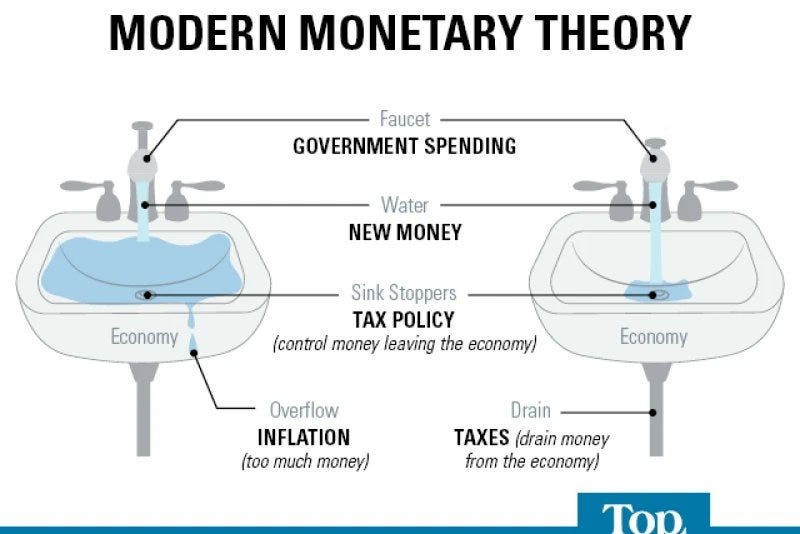
We should not allow the world to fall back into feudalism and aristocracy. We need to redesign the economy with the learnings of modern theories of money. Money is a social construct, and allowing the accumulation of vast amounts of it has created a wildly unequal economy that is only going to get worse. Why should only the capital class be entitled to a good life in an age where AI does all knowledge work? In an AGI future, their participation is equally meaningless – and many of them have their wealth not due to some special talent, but because of circumstances that were beyond even their control.
We need to start reforming our economy now to make capitalism function equitably. There will still be finite resources that need to be distributed fairly. Vote for people who take AI seriously, understand that it cannot be stopped, and argue for monetary reforms that will allow people to continue to participate in the economy until post-scarcity is truly reached. And ask yourself: if your job becomes automated in the next five years, what’s your plan? Where will your income come from? The answer to that question should terrify you into action.
And, if you can, help me to get this essay in front of Eric Schmidt and Elon Musk